
Big Thunder Mountain Railroad Ride Review: Good, Bad & Updated Opossum Outcome

Following a 16 month closure, Big Thunder Mountain Railroad has reopened at Walt Disney World. This covers our review of the refurbished ride, changes to the classic Magic Kingdom attraction, and what else is still coming.
As basic background, Big Thunder Mountain Railroad closed for a lengthy refurbishment project early last January. The ride was down for over a full year for a “crevasse-deep to mountain-top refurbishment” in addition to “new magic” being added to the attraction. The ride returned earlier this month to much excitement and fanfare…plus one minor fire.
I’ve had a chance to ride the refreshed Big Thunder Mountain Railroad several times over the months since it reopened, and have now updated our Magic Kingdom Rope Drop & Early Entry Strategy. With both Frontierland attractions up and running with standby lines and Lightning Lanes for the first time since before Splash Mountain closed, the dynamic is pretty much back to ~2019 normal. Here’s our take on the changes, starting with a new update as of November 3, 2026…
Opossum Outcome
During a media event at Walt Disney World a few months ago, we heard a presentation by leadership about how they spend hundreds of millions of dollars each year reinvesting in the parks & resorts. As part of that presentation, Michael Hundgen, Imagineering Portfolio Executive and Sarah Riles, VP of Magic Kingdom, discussed the BTMRR project.
Despite outward appearances, the Big Thunder Mountain Railroad project was massive in magnitude with a lot of moving parts. Suffice to say, it isn’t easy to replace the entire track, ride vehicles, control system, and other critical infrastructure, all in an operational theme park and around existing thematic environments.
They also touched on the one thing about which diehard Walt Disney World fans have been displeased with this ride refurbishment: The Curious Case of the Omitted Opossums.

This family of cute (or creepy) little fellas hung by their tails from a tree’s branches outside the town of Tumbleweed on one of the straightaways aboard Big Thunder Mountain. (The tree is just out of frame in the above photo.)
Disney confirmed during the aforementioned event that opossums failed ride envelope testing, which checks ride reach to ensure guests cannot conceivably touch anything in the perimeter of the attraction. Walt Disney World representatives assured us that the little fellas are returning, they just need to make adjustments first that could not be accomplished before the ride reopened.
In October, Disney filed a construction permit listing Icarus Exhibits, Inc. as contractor to “install set elements” at Big Thunder Mountain Railroad. This work is now underway, and Walt Disney Imagineering has revealed the first of the new-look opossums:
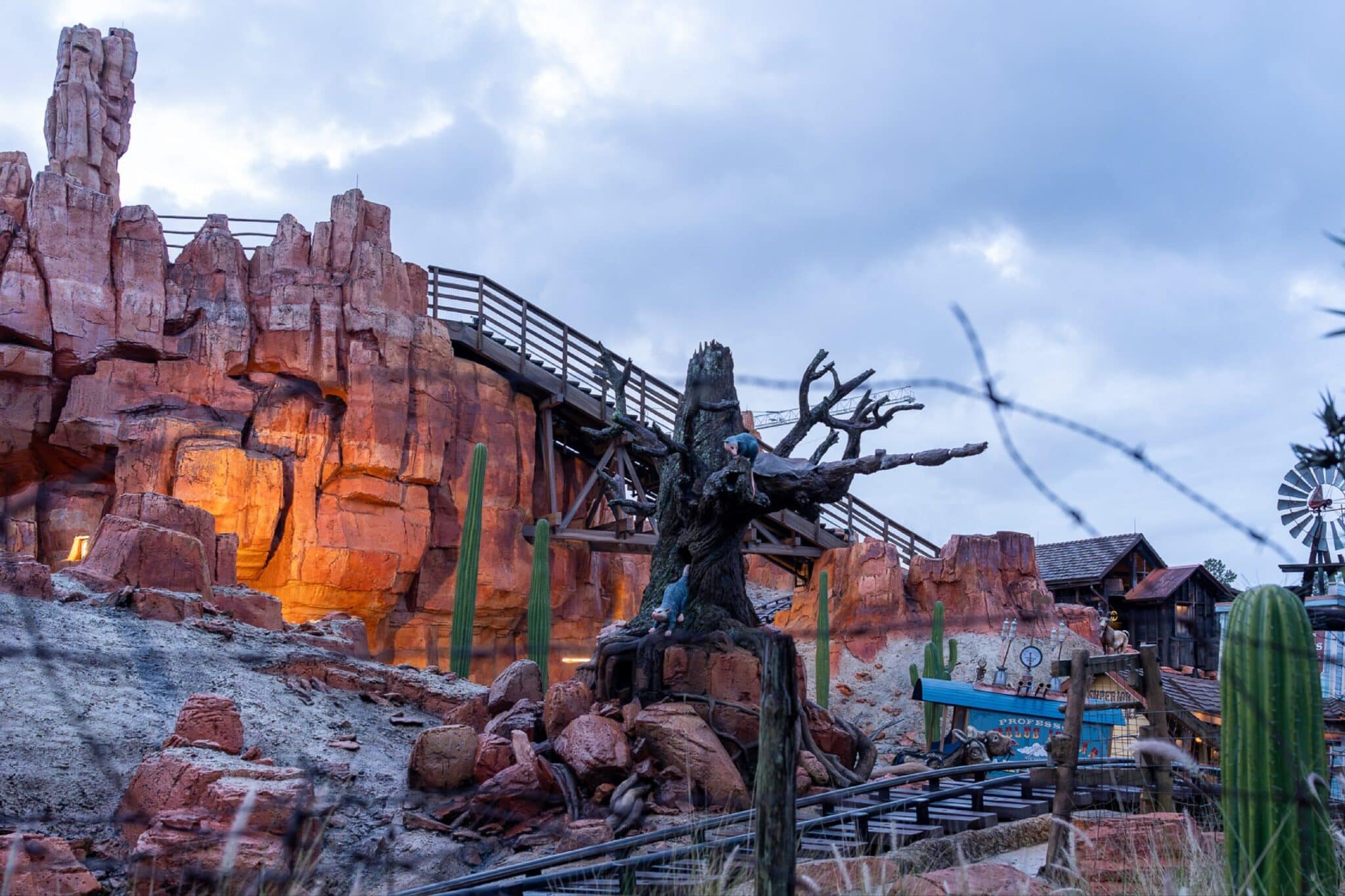
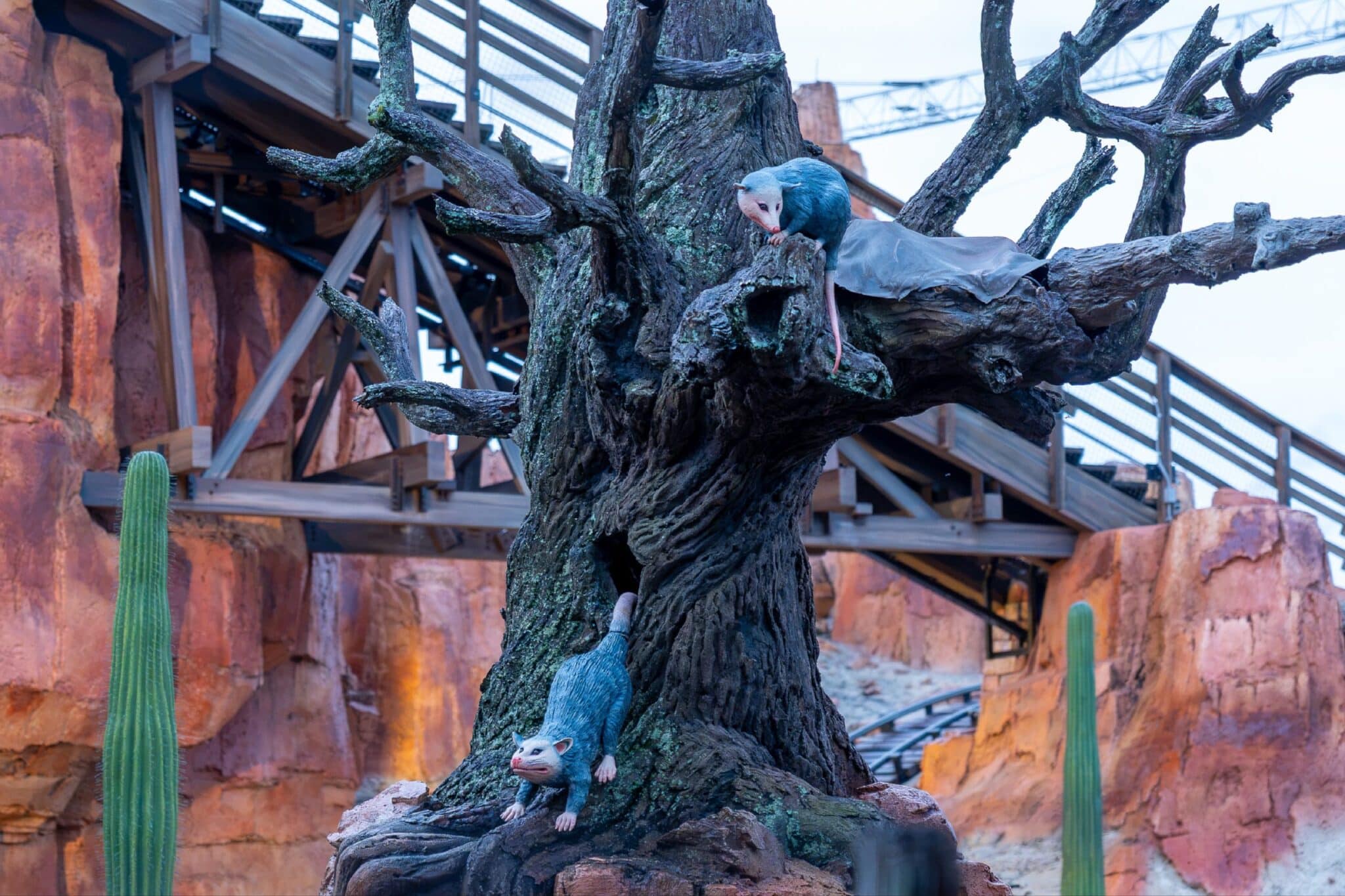
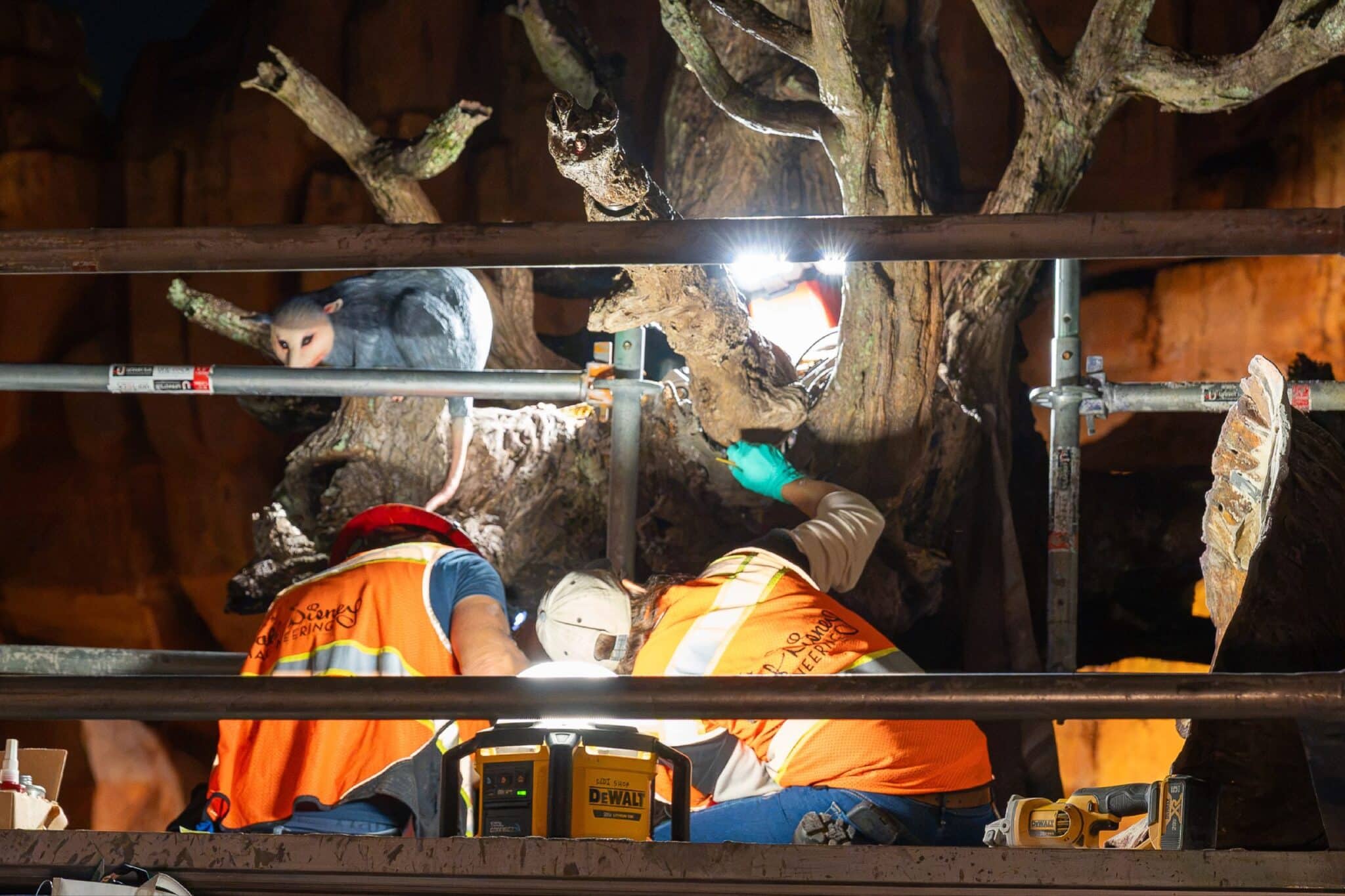
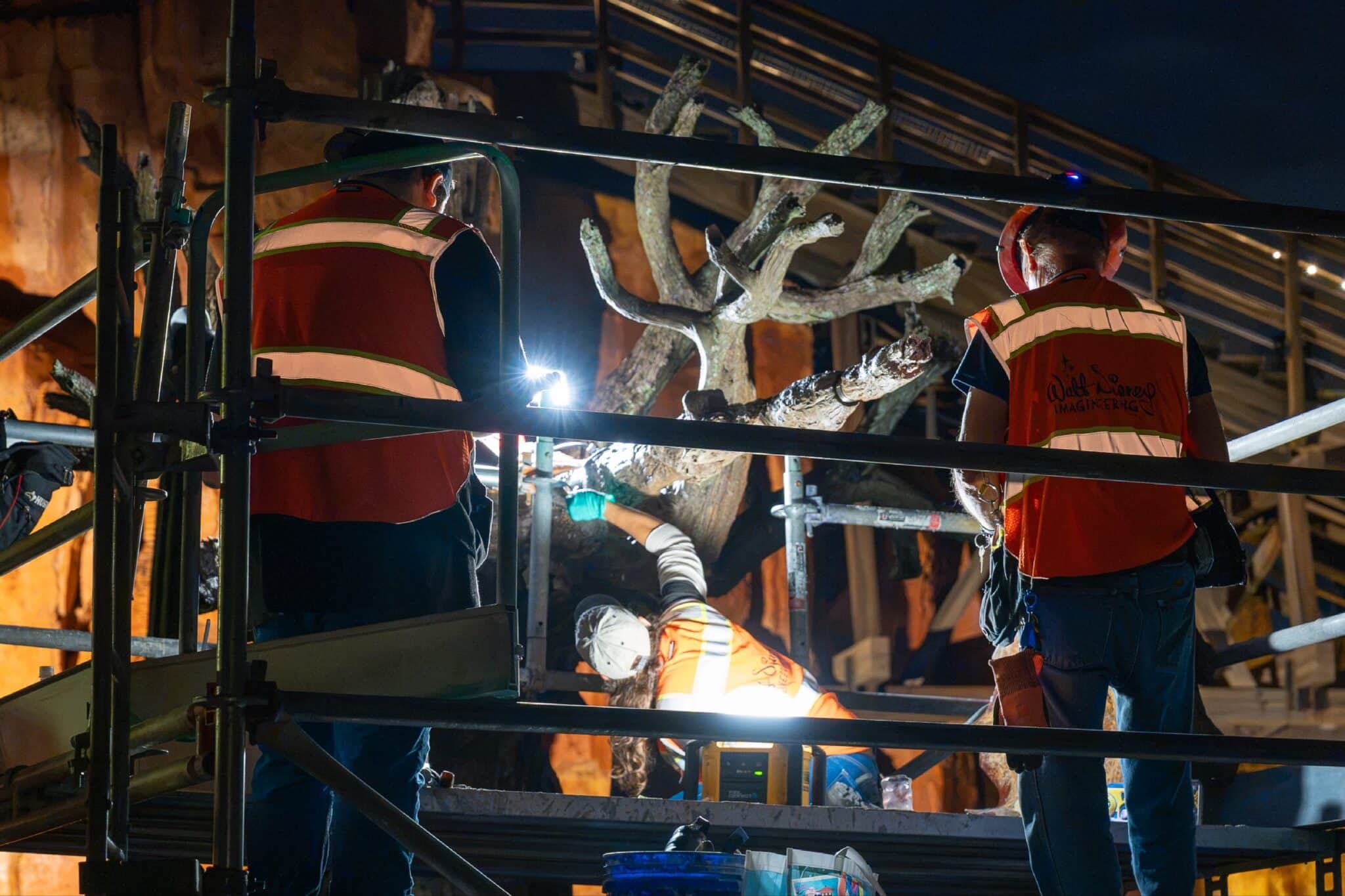
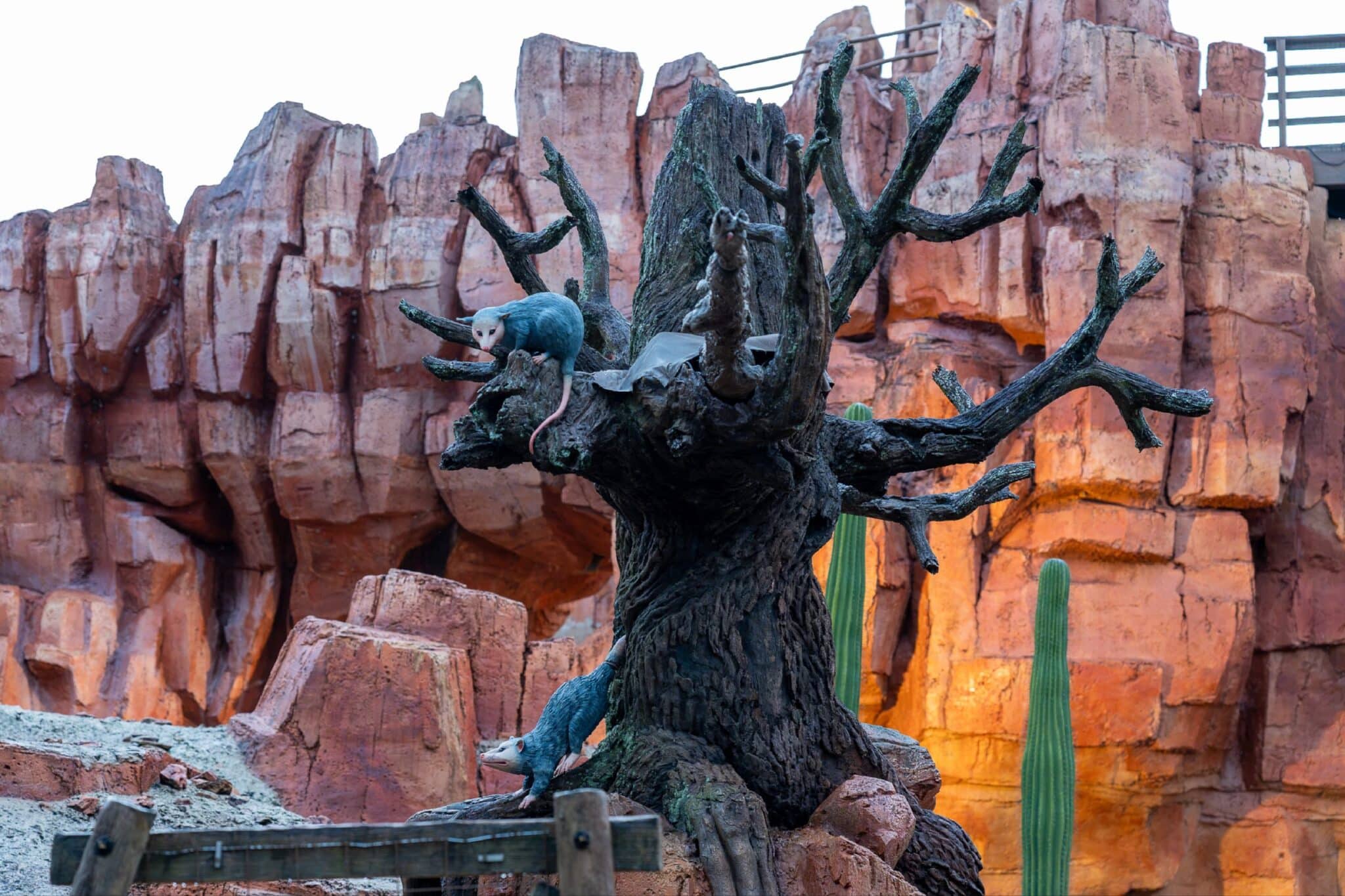
Here’s what Walt Disney Imagineering said on social media: “Imagineers are happy to welcome some old friends home to Big Thunder Mountain Railroad at Walt Disney World! Mom and dad opossum are back, with the rest of the family returning soon.”
One of the two new adult opossums now sits atop a branch, while the other is crawling out of the hollowed out tree trunk. Previously, one of the adults and two kids dangled from a tree branch over riders. It’s unclear whether that near-miss gag will return with the younger (and smaller) opossums hanging again, or if they can’t due to clearance requirements. It likely depends on just how badly the opossums failed the more stringent, modern ride envelope testing since the tree itself was not replaced.
Just based on the tarping still in place on the tree itself and nothing staged on the branch itself, it strikes us as likely that the baby opossums will also move to the trunk. Having them trail the mamma (?) opossum would make sense. We’ll keep you posted, but for now, the regular review of the refreshed BTMRR follows…

New Track & Trains
The key part of the refurbishment was installing a new track and refreshed passenger trains. These updates were carefully planned to preserve the classic attraction’s trademark hootin’ and hollerin’ energy, while adding freshness to the experience.
When riding the refreshed Big Thunder, the track replacement is immediately evident. The ride is smooth instead of clickety clackety, thrilling instead of needlessly punishing. I know some fans favor the rough ride for the sake of the runaway mine train theme, and I get that. But I’m also getting old. At my age, I can still do incredibly intense coasters, but not rough ones.

To each their own, but I view the smoother ride as a big win. I can now loop BTMRR endlessly (and already have!) without my back and butt regretting the decision. Big Thunder Mountain Railroad is every bit as fast and exhilarating as before, just minus the rough ride.
As a parent to a toddler, I’m also looking forward to benefiting from that lowered height requirement of 38” (down from 40″). This may not seem like a big deal, but it’s huge for young families. We just reached the 35″ milestone and did Chip ‘n’ Dale’s GADGETcoaster for the first time, which was actually horrible in the moment but has since become a point of pride and excitement, and look forward to BTMRR as our daughter’s first “big” coaster when she’s ready. Two inches could move that forward by a full year or more!
Regardless of all that, installing a new track & trains and lowering the height requirement by “only” two inches is not the kind of thing that gets Walt Disney World fans excited. I’m not here to tell you that it should, but I do want to offer a bit of context.

First, this type of preventative work is crucial to extend the life of the roller coaster, ensuring the ride’s longevity and operational status for decades to come. As fans of classic attractions, we should be happy to see their future secured. (I’d also note that this is especially important at BTMRR, which has a track record of issues arising from deferred maintenance.)
Second, this type of asset investment isn’t exactly cheap! We aren’t privy to project budgets, but this basically amounted to building a new roller coaster and refreshing the existing thematic elements. While not as expensive as a brand-new attraction, this probably cost a lot more than you’d expect.
Historically, this is the type of non-marketable maintenance project that Walt Disney World has been reluctant to undertake until absolutely necessary given the monetary and time cost, with little needle-moving upside for attendance and guest spending. For years and years, we’ve practically begged Walt Disney World to be more like Disneyland, focusing on maintenance and show quality standards. This is that!

In fact, it’s our understanding that Imagineering has attempted to take BTMRR down for multi-month or year-long refurbishments a few times over the last decade, but just like the mountain itself, Walt Disney World leadership pushed back. As a result, lengthy projects that were previously planned got truncated into routine ‘duct tape’ maintenance to keep the roller coaster running a little longer.
While the ride has had a number of winter closures for several weeks to over a month in the last several years, the last lengthy closure was in 2016 when Big Thunder Mountain Railroad was down for 4 months in the late summer and early fall. Prior to that, BTMRR had multiple closures in 2012 for maintenance and installation of the interactive queue.
Every other worldwide version of Big Thunder Mountain Railroad has had lengthier closures in recent years. The most notable of these was BTMRR at Disneyland in 2013-2014, which yielded much of the same end results with replaced or refreshed infrastructure, along with a complete restoration of the Rainbow Ridge Mining Town and an explosive finale. The Disneyland ‘blueprint’ for this project undoubtedly set expectations for a lot of Walt Disney World fans.

Expanded BTMRR Backstory
The story of Big Thunder Mountain Railroad dates back to the early days of America’s first major gold rush. When Barnabas T. Bullion struck gold in the Big Thunder region, he saw a future full of riches and hustled to start the Big Thunder Mountain Company. At first, the gold flowed freely.
However, those shiny dreams rarely come without a cost, and Bullion quickly found himself in a battle with the forces of nature and in a whole heap of trouble. The easy pickings started to dwindle by the day. Miners were forced to dig deeper and deeper into the mountainside.
Strange and unexplainable things quickly started happening. Despite Bullion’s efforts to continue to push forward at full speed, machines and equipment began to fail. Cave-ins shut miners out of rich strikes, and rumbles of thunder came from deep inside the angry mountain.

As Bullion’s grand operation crumbles beneath the weight of the protective forces of the mountain, a substantial vein of gold hasn’t been found in months inside the mines, and very few miners (outside a few, brave seekers) remain based in the area.
That’s the ride premise in a nutshell. The Barnabas T. Bullion and Big Thunder Mining Company tall tale was already one of our favorite backstories at Walt Disney World, and this just heightens it for me. I also appreciate that it’s not necessary to know or understand all of this to appreciate BTMRR.
A CliffsNotes version of the story is signposted by the attraction itself and evident to even casual riders. That’s exactly how this should be, with a surface level story that’s clear to all along with deeper details and lore for the diehards. Big Thunder threads that needle perfectly, and is a good contrast to nearby Tiana’s Bayou Adventure, which manages the exact opposite: both way too much lore and not enough on-ride story.

Enhanced Rainbow Caverns
Throughout the refurbishment, Imagineering teased that Big Thunder Mountain Railroad would reopen with “new magic” for Walt Disney World fans to discover.
One such moment comes when the trains rattle their way underground to spectacular natural caverns full of phosphorescent pools, shimmering and illuminating iridescent stalagmites (the ones on the floor) and stalactites (the ones on the ceiling). There’s also a veritable swarm of bats.
The new lighting package here is a loving nod to Disneyland’s defunct Mine Train Through Nature’s Wonderland. It’s vibrant and majestic, and adds a lot to the attraction’s opening act. As one of the longest ‘scenes’ in this roller coaster, improving this was a smart move.
What I most appreciate is this scene’s simple and straightforward conveyance of the aforementioned story. With a flash of lightning, the beauty gives way to ominous red lighting that warns you something’s about to go terribly wrong and you need to leave (pictured below). This isn’t anything mind-blowing, but it’s effective and well done.

Mother Lode of Gold Finale
The most controversial change to Big Thunder Mountain Railroad comes in the finale. For over a year, Walt Disney World fans had speculated about the explosive ending with dynamite blasting riders out of the mountain found at Disneyland.
While we originally assumed that would be added, we’ve been cautioning readers not to get their hopes up for that since last August. Even so, fans were understandably disappointed when the dynamite finale wasn’t cloned over. It’s a fun effect that works well (when it works).
I’m not going to fixate on this too much since it’s bound to be an unpopular opinion, but I like the Mother Lode of Gold finale at Magic Kingdom’s Big Thunder Mountain Railroad. But perhaps I’m just a MK Mountain Range contrarian, because I also prefer our Space Mountain!

I appreciate that the gold finale is different on each coast. The shimmering strike being in plain sight but just out of reach fits both the story and the cautionary tale nature of the attraction. If you want to be pedantic, I also think it’s possible to question the why? of the dynamite finale at Disneyland within the story.
At the same time, I also recognize that the Mother Lode of Gold finale was undoubtedly cheaper than the explosive ending at Disneyland. That’s unquestionably the bigger wow-moment and more fun effect. It’s more ambitious and impressive, despite being over a decade older.
The Mother Lode of Gold finale could’ve been even better than that with modern technology, plus a bit more time and money spent on it. With this being such a lengthy closure, it is disappointing that Disney didn’t invest more in an actual show-stopping scene here.
I also think that the execution here is only okay, and it could’ve been conveyed more effectively that the mountain isn’t letting you have the gold. So while this finale is better than what was here before, it still falls short of reasonable expectations.
In the end, the Mother Lode of Gold finale feels like a missed opportunity. This is unfortunate, especially since Imagineers clearly put a lot of love into this project, fixing long-dormant effects and making Big Thunder Mountain Railroad look and feel the best it has since I’ve been visiting as an adult. But by failing to seize the opportunity to add something show-stopping after such a lengthy project, WDW diehards are going to walk away saying “that’s it?”

Ultimately, the refurbishment of Big Thunder Mountain Railroad doesn’t reinvent the wheel. Few fans are going to experience this and think of the ride as having been redone or reimagined. Even though, ironically enough, the track replacement and new trains make it closer to “all new” than any of the recently refreshed rides that we’re more likely to view as reimagined.
The improvements to Big Thunder Mountain Railroad are important. Most of them just aren’t as visible as those in other smaller-scale, shorter projects. Even so, the expanded backstory, new lighting in the Rainbow Caverns, and Mother Lode of Gold finale, among other things, are all appreciated enhancements.
Big Thunder Mountain Railroad is a classic for good reason, and it’s great to have this iconic attraction operating at Magic Kingdom for the first time in over a year. It’s also fantastic to see Walt Disney World investing in needed maintenance, preservation, and TLC.

A ton of time, money, and passion was invested into this year-plus track replacement and top to bottom refurbishment project, restoring long-dormant effects, improving show scenes, and other little things. It might seem basic, but that’s the type of thing we’re used to seeing Disneyland do, but Walt Disney World much less so.
More than the guest-facing changes, the Big Thunder Mountain Railroad project is significant in what it symbolizes. It’s this type of project that makes me more confident both Walt Disney Imagineering and Walt Disney World are on the right track, headed in the correct direction. Here’s hoping it doesn’t get derailed before future projects can come to fruition.
Planning a Walt Disney World trip? Learn about hotels on our Walt Disney World Hotels Reviews page. For where to eat, read our Walt Disney World Restaurant Reviews. To save money on tickets or determine which type to buy, read our Tips for Saving Money on Walt Disney World Tickets post. Our What to Pack for Disney Trips post takes a unique look at clever items to take. For what to do and when to do it, our Walt Disney World Ride Guides will help. For comprehensive advice, the best place to start is our Walt Disney World Trip Planning Guide for everything you need to know!
Your Thoughts
Have you experienced the refreshed Big Thunder Mountain Railroad? What did you think of the new track, trains, Rainbow Caverns, Mother Lode of Gold finale, or anything else? Excited for the iconic attraction to be back? Do you agree or disagree with our assessment? Any questions we can help you answer? Hearing your feedback–even when you disagree with us–is both interesting to us and helpful to other readers, so please share your thoughts below in the comments!
I completely understand being happy for the smoother ride getting older (hitting 41 in about 30 days), but our whole family (41, 40, 8, 13) were all disappointed with the new version of it when we rode it a few months back. So much so that we immediately were saying we’re okay not doing that again anytime soon, which is sad since we loved the prior version. I get it, it’s a family oriented park/ride, but it’s still nice to have something a bit more rough than everything else in the park.
If the BTMRR bar restraint system works at the loosest position if the height requirement is met, why have a bar at all?
Is it to make people “feel” a measure of safety when riding? If so, what about smaller, leaner people sitting next to a large, heavy person? The bar locks in an absurdly loose position for the smallest occupant, who feels zero sense of protection.
I maintain that Individual restraints is the only way to go, and should have been installed long ago. Physics and mathematics may keep a person from falling out of the ride, but they don’t account for any feelings of safety or lack thereof.