
Disney World Raises 2027 Ticket Prices to New Record of $219, With More Increases Likely for Christmas
Walt Disney World has released tickets for next year, with (unsurprisingly) price increases for 1-day, multi-day, base and Park Hoppers for January through October 31, 2027. This post has pricing for 2026 vs. next year, details on the increases along with commentary offering our thoughts.
Let’s start with the good news. Prices did not increase on 2026 tickets, only on newly-released 2027 dates. This follows the precedent established for each of the last few years, which was to not raise rates on existing inventory, but only the new product release. Prior to that, prices went up in February and/or October (and sometimes December!) on the current and coming calendar year’s tickets.
For reference, last year there were two waves of ticket releases. The first occurred in the spring and covered dates for January through October 31–just like what’s happening now. The second occurred in the fall and covered November and December. This is key context that’s necessary for an apples to apples comparison.
Last year and this year, prices hit new all-time record highs in December. Not surprising given that encompasses the weeks of Christmas, and New Year’s Eve–and those are the most expensive weeks of the year, on average, at Walt Disney World.
The good-ish news, at least for on-site guests, is that Walt Disney World has also ramped up discounts significantly in the last two years. Walt Disney World has effectively brought back the 2019 deal playbook and then some, offering discounts on par or better than that year.
After slim pickins’ on deals during the revenge travel era, WDW has gotten very aggressive with deals. This potentially points to Walt Disney World going overboard on price increases, but “needing” them to show growth to Wall Street.

With the latest wave of discounts for this summer on tickets & resorts plus the stackable Kids Eat Free promo, we’re seeing lower prices for Walt Disney World vacations than pre-COVID.
Of course, that’s also not apples to apples as perks have been cut as compared to 2019 (and because you have to purchase the specifically discounted resorts and tickets to take advantage). But it’s still encouraging to see this downtrend.
All of this is why we routinely point out that Walt Disney World has adopted the “Kohl’s Model” to pricing, where the sticker prices are almost meaningless due to discounts. Kohl’s learned ages ago that if the base price is higher, it makes the discounted rate look like even more of a bargain. And that’s often what Disney seems to be doing with higher base prices, but also bigger and better deals.
Walt Disney World leadership studied at the Kohl’s School of Business, and learned that same lesson during the Great Recession. Since then, we’ve seen prices keep going up, even as discounts get better.
The end result is an overall value proposition for 2026 that’s much better than 2021-2023, all things considered. And for Summer 2026, specifically, affordability is as good as 2018 or 2019, especially if you have kids in the sweet spot age range of 3 to 9 years old.
But you’re probably here for the 2027 ticket price increases, not a primer on Walt Disney World pricing and discounting. (I just personally find that fascinating, and illuminating context for the changes.) As a general matter, Walt Disney World’s date-based ticket pricing system makes price increases very difficult to assess.
This variable pricing obfuscates changes by design, and it’s thus difficult for us to fully track price increases. The good news is that, as noted above, Walt Disney World did not raise 2026 prices with the release of the annual product for 2027, so it’s a pretty easy before/after by comparing this year to 2027 on the official WDW ticket pricing calendar.

Here are the existing single-day peak ticket prices for January through October 2026:
- Animal Kingdom: $179
- EPCOT: $194
- Disney’s Hollywood Studios: $199
- Magic Kingdom: $199
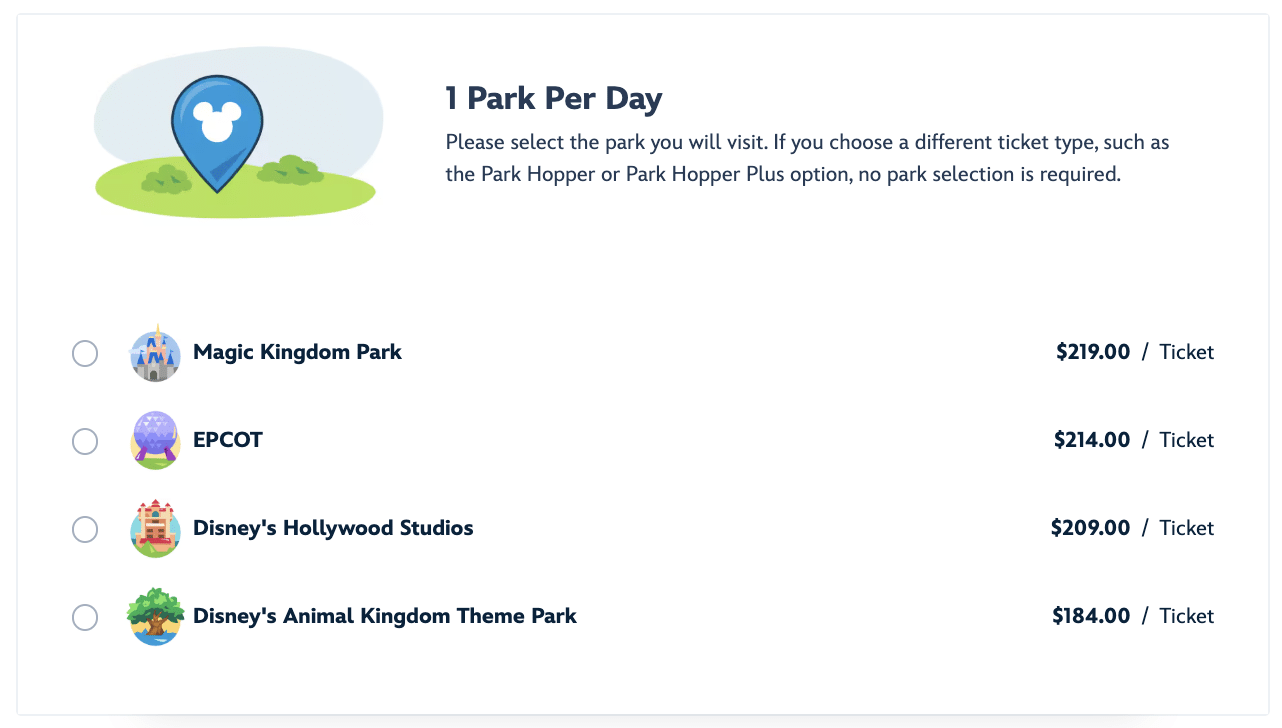
Here are the new single-day peak ticket prices for January through October 2027:
- Animal Kingdom: $189
- EPCOT: $214
- Disney’s Hollywood Studios: $209
- Magic Kingdom: $219
That amounts to the following increases:
- Animal Kingdom: +$10
- EPCOT: +$20
- Disney’s Hollywood Studios: +$10
- Magic Kingdom: +$20
There are a number of dates when one or two of the parks hits their new highs around Spring Break and Fall Break 2027. The one day when all of them hit these peaks is Fall Break (October 9, 2027):
On a positive note, the price floor remains unchanged for this year versus next. Not only that, but we’re seeing about the same number of $119 dates for DAK between August and September of this year and next.
And although it broke the $200 barrier for the first time, prices on most dates at EPCOT aren’t up that much. (EPCOT is really feast or famine with crowds–we wouldn’t be surprised to see a massive increase for NYE given the colossal crowds there this past year.)
Here are the existing single-day low ticket prices for January through October 2026:
- Animal Kingdom: $119
- EPCOT: $129
- Disney’s Hollywood Studios: $139
- Magic Kingdom: $139
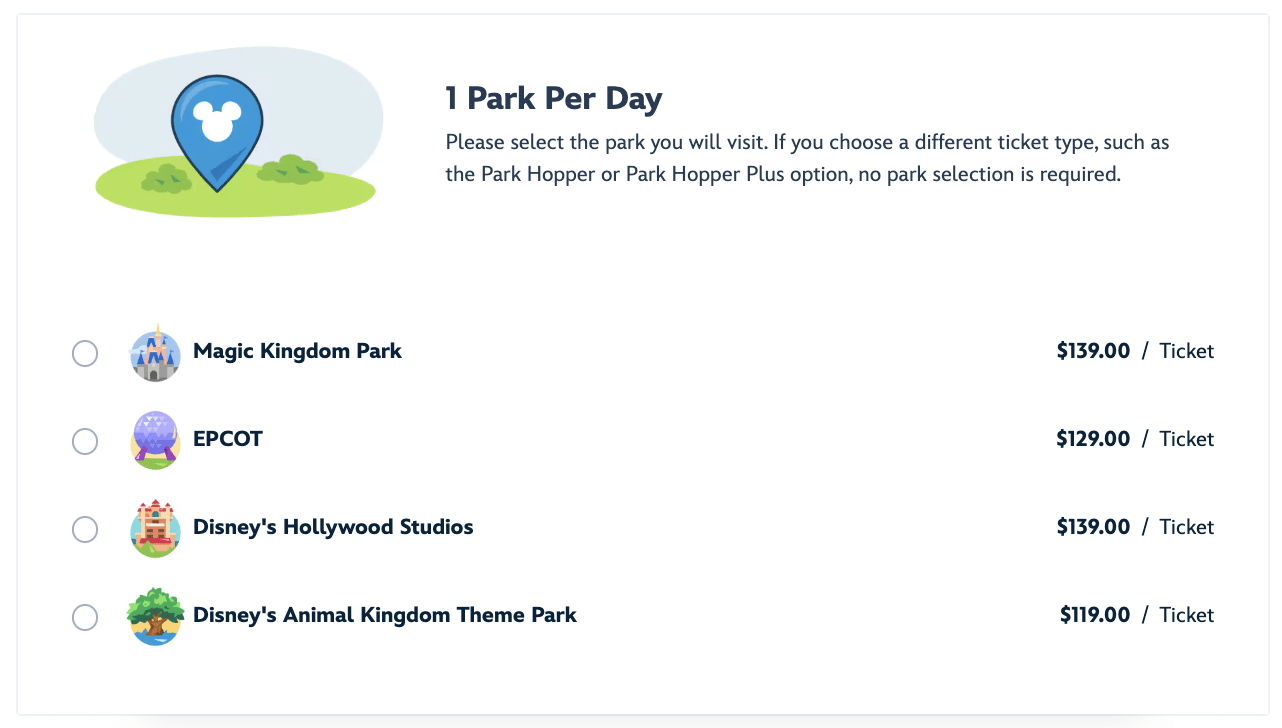
Here are the new single-day low ticket prices for January through October 2027:
- Animal Kingdom: $119
- EPCOT: $129
- Disney’s Hollywood Studios: $139
- Magic Kingdom: $139
There aren’t a ton of dates with these prices points (in fact, I could only find one when all four parks were at their lows: August 31, 2027), but they do exist.
You might see other websites with numbers that differ from these and contend that prices are only up $5 to $10. This analysis is misguided. They are arriving at these conclusions by comparing January through December 2026 to January to October 2027.
That might seem fair at first blush, but the problem with that comparison is that December has the most expensive weeks of the year. So if you include those weeks for this year but exclude them for 2027 (because current tickets only go to October 31, 2027), you’re making an incomplete comparison!
Unless next year totally defies past precedent, Walt Disney World will set new record high ticket prices starting Monday, December 20, 2027. From that date through December 31, 2027, all four parks will set new records for their all-time highest prices.
Three of the parks will likely increase by another $5 to $10 each for those dates, with Magic Kingdom up another $10 or more. Just like this year versus last year. In other words, we have to wait until later this fall for a complete year-over-year picture; the only comparison worth making right now is Jan-October 2026 vs. Jan-October 2027.

The most expensive prices of January through October 2027 occur exactly when you’d expect them: Presidents’ Day, Spring Break, Easter, and Fall Break. In comparing year-over-year prices (adjusted for the timing of different holidays), all of these prices are up–setting new record highs for their respective weeks.
Offering the caveat that I’m not doing comprehensive data analysis beyond that, and am instead spot-checking dates throughout the calendar, it appears that most dates and parks are up (on average) around $10 year-over-year. Generalizing further, the average price increase is in the 5% ballpark. This is not a hard and fast rule, and doesn’t impact all parks equally.
Magic Kingdom is up more for 2027 than the last couple of years. My theory here is that, now that they’ve broken the $200 barrier for peak season dates (which happened last holiday season), they’re more comfortable pushing past it and charging market rates for peak dates.
This is a trend we’ve spotted with Disney pricing: reluctance to cross a big line that might have ramifications with consumer psychology for longer than “necessary” (based on demand), but once they do, blowing based it and resetting the ceiling. We’ve seen the same play out repeatedly, most notably/recently with Mickey’s Not So Scary Halloween Party peak prices last year. (Speaking of which, don’t be surprised by another huge jump on the high end there.)

As underscored by the price floor remaining unchanged, Walt Disney World did not take a blunt instrument approach to price increases. There are not simply higher prices by ~5% across the board. There are many dates from May through July 2027 that are up between $0 and $5 at EPCOT, DAK and DHS. It looks like Magic Kingdom is often up by more than that, which could be explained by the aforementioned reset.
It’s a similar story in August and September 2027, which are the months that maintain the price floor. This isn’t surprising, as those months have historically seen the lowest price growth. Those two months are firmly the off-season, offering the lowest prices of the year and the lowest attendance. I’m not inclined to do more than cursory analysis to off-season sticker pricing, since it’s meaningless in the end due to discounts. (See above comments about the Kohl’s Model.)
I’ve said it before, but it still baffles me that Walt Disney World doesn’t offer $99 tickets to Animal Kingdom during those months. The marketing value alone strikes me as worth it, and that’s doubly true when you consider how keen Disneyland is on touting its increased number of $104 dates. (And those are available not just at DCA, but also at Disneyland–and on dates when the park is often open from 8 am to 11 pm!)
Raising the peak prices and maintaining the floors suggests to me that Walt Disney World is cognizant that is has room to push prices higher on the dates when the parks are busiest, but that lowering the base prices won’t yield higher attendance in the off-season.
This is not new or novel analysis about demand elasticity, and it’s something we’ve seen play out for years–if not decades. Walt Disney World’s demand is driven by school breaks and holidays, and that remains true even as prices reach stratospheric levels.
Guests purchasing the priciest options do not have the same degree of price sensitivity as the average guest or American consumer. I’m slightly surprised Walt Disney World is not taking full advantage of that, and instead has below-market prices for peak season dates.
I am curious about metrics other than spending during the worst of these dates. For instance, are intent to revisit or recommend lower around Presidents’ Day, Easter, Fall Break, Christmas, and New Year’s Eve? I assume so since Walt Disney World has proactively shared that those stats have been higher during recent summers.
But also, how much does it matter? If there’s an almost endless supply of one-off tourists willing to pay $219 for single day tickets to Magic Kingdom on those dates, perhaps that’s fine. Make up for the other metrics on other dates.

A big consideration on both ends of the pricing spectrum are optics. That’s why we think that, on the one hand, $99 tickets for Animal Kingdom in August and September would be savvy. While on the other hand, we believe there was reticence about breaking the $200 barrier at Magic Kingdom last Christmas, even though the prices were (and arguably still are) below market.
There’s a new piece on how Walt Disney World is pricing out average middle class Americans or its own fans are finally reaching their breaking point almost every other week. This is increasingly common sentiment among both diehard Disney fans and the general public at large, and the backlash seems to be growing. There’s a lot of validity to the perceptions that Walt Disney World is increasingly out of reach.
We’ve been critical of the company, with Is Disney Ruining Its Reputation? and Disney’s Reputation Falls Further (among several other posts) covering the company’s self-inflicted brand damage and loss of goodwill. That has happened, at least in part, because Walt Disney World is charging more and offering less as compared to 2019.
Then there’s the reality that sticker prices only matter so much. They certainly do with 1-day tickets, which are a big seller and are seldom discounted. It’s a similar story with hard ticket events, like Mickey’s Not So Scary Halloween Party.
But for almost everything else, special offers have become so abundant and aggressive that raising the sticker prices is less meaningful–the eventual deals are what matter more. And with offers like the Deep Discount on Rooms Starting at $99 Per Night and 4-Park Walt Disney World Magic Ticket, prices are cheaper this summer than they’ve been in years.
The thought process for 2027 prices is probably more of the same with the Kohl’s Model to pricing. Raise the sticker prices, capture the revenue that can be captured by doing that, and then offer discounts to backfill rooms and park attendance. It’s not necessarily a bad strategy; it’s one that works until it doesn’t.

The notion that it works until it doesn’t is precisely the problem. Not everyone is reading sites like this, stalking disneyworld.com, waiting for the next special offer to drop to bring prices down to their level. Many people price out a vacation once, and view the price they see at face value–it either is acceptable or too high. That’s it; they’re done. Either out or in right then.
My concern is that there’s already growing economic uncertainty and travel trepediations, at the same time that consumer confidence dips, fears of a recession rise, gas prices climb, and international travel decreases. Of course, that’s in the here and now–things could be better or worse by 2027.
Regardless of how that plays out, we want to reemphasize our strong belief that Walt Disney World needs to take a hard look at affordability for middle class American families. They did exactly that last year and with the 2026 product launch, but it appears they’re getting away from it with recent deals (or lack thereof) and 2027 product.

More parents being able to afford to take their kids to Disney for a day is a good thing. For one thing, Walt Disney World absolutely needs that pipeline of young fans who grow up on the parks. Childless Disney Adults are a great and lucrative demo, but they’re fundamentally different.
For the future health of the fandom, the parks, and the company, Walt Disney World really needs to ensure parents keep bringing their young children on rite-of-passage trips at a formative age. I’d like to believe that is truly what Walt Disney would’ve wanted when he talked about middle class accessibility, as opposed to pretending he’d be upset about whatever personal pet peeves I have with pricing.
Planning a Walt Disney World trip? Learn about hotels on our Walt Disney World Hotels Reviews page. For where to eat, read our Walt Disney World Restaurant Reviews. To save money on tickets or determine which type to buy, read our Tips for Saving Money on Walt Disney World Tickets post. Our What to Pack for Disney Trips post takes a unique look at clever items to take. For what to do and when to do it, our Walt Disney World Ride Guides will help. For comprehensive advice, the best place to start is our Walt Disney World Trip Planning Guide for everything you need to know!
Your Thoughts
What do you think of these Walt Disney World ticket price increases for January through October 2027? Will you still be visiting the parks next year, or are you priced out? Do you agree or disagree with our assessment? Any questions we can help you answer? Hearing your feedback–even when you disagree with us–is both interesting to us and helpful to other readers, so please share your thoughts below in the comments!





Here’s an excerpt from a recent post about a fuel charge on Mears Connect (https://www.disneytouristblog.com/disney-world-airport-shuttles-new-fuel-fee-due-to-rising-gas-prices-could-be-canary-in-coal-mine/) that feels relevant:
We’d also add that the thinking that rising costs “only” adding another $X won’t be make or break. This is something we see constantly when it comes to the new fiscal year price increases, often condescendingly framed. That if families can’t afford another couple hundred of dollars, maybe they shouldn’t be visiting in the first place.
I’ve always felt that the more honest framing would be: my family can still afford to go after these higher prices. But everyone has a breaking point. If we subscribe to the logic that each incremental increase is “only” $X, we can justify endless nickel & diming and ever-rising costs. Everyone has a budget, though, and there’s a point at which those higher prices put a trip out of reach.
This isn’t conjecture (“budgets are a thing” should be self-evident without much further explanation). We’ve seen this play out in recent years as Walt Disney World attendance still remains well below 2019 levels as the company raises prices to chase higher per guest spending–or more revenue on fewer visitors.
If Disney wanted higher volume, they could easily achieve that by lowering prices and expanding the pool of income qualified guests. And I’d be careful what you wish for with shrinking that pool as opposed to growing it, because there comes at price point at which you, too, shouldn’t be visiting in the first place. Again, though, all of this should be fairly obvious.
Disney should rise prices to whatever makes them the most money. There is nothing morally wrong with that. Customers likewise should spend money on the things they think are worth it. No customer feels bad for failing business, why should businesses feel bad for customers who can’t afford something? There is no good or bad in this equation its just an exchange of money for services. They aren’t manufacturing insulin.
Harry – I would (as I did at the end of the post when discussing the ‘pipeline’ of young fans) argue that Disney is largely in the business of selling nostalgia, and for that to succeed (which enables them to charge premium pricing for their product), they need to make pricing decisions with an eye towards both the short-term and long-term.
In the short term, it absolutely behooves them to focus on DINKs, as that’s a highly lucrative audience with the money to spend. But that’s a risky approach in the longer run given the multi-generational nature of the beast. This isn’t speculative; I’ve heard Disney leadership talk about needing to find this balance. (And recent discounting reflects as much.)
Thanks for revisiting this post, Tom. Some people read a little Ayn Rand and apply that free market “it’s a doggie dog world” Darwinian harshness toward realms such as Disney World which clearly was built by its founder to be accessible to normal middle class families,. not just those who celebrate price increases as ultimately bringing them more space to walk around,..
“Disney is largely in the business of selling nostalgia, and for that to succeed… they need to make pricing decisions with an eye towards both the short-term and long-term.”
I disagree with the premise that current pricing risks future nostalgia. Every generation, now and forever, will have its own set of memories and IPs that can be monetized. Suggesting that today’s pricing models will cripple future success isn’t based in reality. If anything the parks have shifted away from “park nostalgia” and leaned heavily into modern IP…and popularity has exploded because of it.
Regarding the focus on DINKs… I didn’t mention them but even if Disney targets that demographic, saying it will damage the park’s financial future is speculative. The reality is that this is a function of growing wealth inequality. As the cost of living rises, casual entertainment across the board…concert tickets, gaming, theme parks…is naturally pivoting toward the segment of the population that actually has discretionary income.
As the pool of people who can afford luxury extracurriculars shrinks, companies maintain margins by increasing the yield per guest. This isn’t a moral failing it’s just market reality. There are endless alternatives for entertainment. I can’t afford a Lamborghini, but I’m not mad at Lamborghini for it.
People are understandably upset to be living through this shift, but the lack of sympathy is a two-way street. Customers don’t lose sleep over a failing business that’s begging for their dollars, and they’d abandon Disney in a heartbeat if a better cheaper alternative appeared. Why should a successful company feel a moral obligation to customers who would feel no such loyalty to them?
Our economic system is not terribly supportive of families and at Disney this is more of a shame. Children tend not to earn money and so charging them nearly the same price as adults is discouraging. One child should be admitted free per paying adult. If you are a SINK (Single Income Nine Kids) it will be tough. But ignore those posing as hard-ass capitalists who claim businesses are meant to squeeze out every dollar they can and that’s fine. Walt Disney believed he was giving a gift to humanity,.. and the brand is much about that legacy of good will; when that is found to be a front then Disney will lose the fan loyalty, the continuity kept by those who speak the language,., and if you have a generous heart you don’t want only wealthy folks to experience what you think is good,.. a vacation should be slightly costly but not so much as to make you wince throughout the entire span of it, which is an expression I have come to recognize in the faces of Disney tourists,..
Do these price increases really make or break a trip for a family? If the average week long trip to Disney for a family of four is around $10k….another couple hundred in this ticket price increase is going to break the bank? Seriously?
On one hand, I agree with Harry.
On the other, some parents work very hard and are not as fortunate as Harry.
So hopefully, those parents can maybe find discounts, pack lunches and snacks so thier children can feel the magic too.
I also feel that there should be a discount for seniors over 75. I take my children and my grandchildren along with my 99-year-old mother to Disney.
99-year-old mother who just goes to be by her family has to pay the outrageous prices as well. Granted there are not many rides than a 99 year-old can do.
If she does spend money on food and drink. So I do feel there should be a discount for people over 75 since they don’t ride all the rides.
The thing on that everyone has their own opinion on pricing.
Kohls is not something Disney should ever aspire to be.
A prediction – there will be some really good deals attached to DVC in the future. At the moment DVC doesn’t make a ton of sense to me, unless people are buying in with a really long view, like thinking about how much cheaper their stays will be in 15 years after prices have gone up significantly. Absent that, the flexibility that comes with renting points or looking for other Disney deals makes more sense. Given that they have a lot of units to sell, this seems like a probable outcome. I doubt DVC ownership, even as it expands, encompasses enough people to impact park profits if it included steep ticket discounts. For individual buyers, however, it could mean DVC paying for itself much faster.
They need to triple the prices to keep the scumbags out
30 years ago it was about $30. and they had more entertainment and less crowds…..
I know you maintain that most guests are newbies which I have difficulty believing but when we are heading to a resort in a few weeks and get emails introducing us to Disney World as if we have not already visited dozens of times over the years, i just have to wonder how adept they really are at handling data,. what’s the point of submitting to the myriad trackings if they don’t seem to recognize our loyalty,.a dwindling loyalty since it is very hard to justify a family of four spending around 1K per day for the entry that increasingly seems like a cover charge for restaurants, where that same money can go toward a cruise which includes meals, romantic horizons and all the enchantments one would have to work hard to get at the parks? What would be even more ironic is if you Tom also get those formulaic intros to Walt Disney World,. Did you know there are 4 parks and 2 water parks as well?
You’re 100% right about Disney being terrible with data. It’s been a few years, but I’ve talked to people in IT who have confirmed as much–that all of the assumptions fans make about Disney using park reservations, ADRs, etc. to forecast crowds/staffing/etc. are all wrong. How they actually do things is very rudimentary, which is why they’re so often behind the curve. It also, indirectly, explains some of the not-so-targeted emails.
As for the first-timer vs. repeat guest split, my understanding is that comes from the survey team. They are actually incredibly adept at that, and gleaning info about guest satisfaction and other key metrics. They also know when “levers” need to be pulled to maintain that dwindling loyalty.
well, thanks Tom,. and to any Disney higher-ups reading, I got a lever you can pull!
I agree you should stop going to the parks
We were hoping to find a way to go for a week next year (two adults and two kids) but it looks like it will not happen because it is just too expensive. Great job Josh D’Amaro! Continue the tradition of screwing the middle class!
As noted somewhat throughout the article, if this singular price increase is what tipped your scale in not being able to go – it likely wouldn’t have worked out anyway. There will be significant discounts throughout the year, and unless you are going during peak times, pricing isn’t all that much more. Flexibility in dates will be key. I get not everyone can go any date, but as of the moment there are more than enough travelers willing to pay a premium to visit during the busiest weeks of the year.
well, Aaron, that’s a little harsh,..while staying at the Swan on Friday May 8th the day before a cruise, to step into Epcot, just to stroll around without any real expectation of riding any of the hot ticket rides, just for the atmosphere will cost $815 for 2 adults and 2 children on what doesn’t seem to me like any kind of especially prime vacation time,.. I am not boasting but we are financially secure to say the least but perhaps based on my age and remembering what a dollar meant decades ago I can’t justify such a cost but I believe most young families don’t have nearly the discretionary income we do and it just seems like way too much money without adding hotels, transportation and food into the equation,..
Well, Rorosen, no one is forcing anyone to go to disneyworld. Something is worth what people are willing to pay. More people than ever want to go to disney so they can charge more. That’s how it works and how it should work. If Disney was a failing company and begging customers to come so they wouldn’t go out of business no one would feel bad for them, just like Disney shouldn’t feel bad for people who can’t afford to go. We aren’t talking about a company that produces life saving medicine pricing people out, it’s an entertainment option amongst a million other entertainment options. I want a lamborghini, I can’t afford one, I’m not mad at lamborghini for making it unaffordable to me. No one on either side of the equation between business and customer owe each other anything. They make a product that a lot of people want, and are willing to pay a lot for, if anything they are still underpricing their value- that’s why they keep increasing prices and people don’t stop going. If you don’t think its worth it, don’t go, more walking space for the rest of us.